
Artificial intelligence is no longer a "future" technology—it is a current competitive necessity. However, the biggest mistake most businesses make isn't ignoring AI; it's trying to automate the wrong things first. Leaders often get distracted by "shiny object syndrome," chasing generative tools that look impressive but don't actually move the needle on the bottom line.
At our agency, we believe the most successful AI implementations aren't the flashiest ones—they are the ones that quietly give your team 10+ hours back every week. These "invisible" wins are what scale companies. In this guide, we’ll show you how to audit your current operations to find the "low-hanging fruit" where AI can deliver immediate, measurable impact.
01. Map the "Data-Heavy" Bottlenecks
Before looking for a tool, look for the friction. Identify tasks that involve moving data from one place to another—such as CRM updates, invoice processing, or summarizing meeting notes. These are prime candidates for AI.
Think about the "swivel-chair" effect: a team member looking at one screen and manually typing that information into another. If a task requires a human to "copy and paste," "reformat," or "reconcile," it should probably be handled by an AI agent. These bottlenecks don't just waste time; they are where human error is most likely to creep in, leading to costly mistakes in your records.
02. Prioritize Frequent vs. Complex
Don’t try to automate your most complex, rare edge cases first. A common pitfall is spending $10,000 to automate a process that only happens once a quarter. Instead, focus on high-frequency, low-complexity tasks.
The 80/20 rule applies here: 80% of your manual labor usually comes from 20% of your routine tasks. Automating a 5-minute task that happens 50 times a day yields a much higher ROI than automating a 2-hour task that happens once a month. Start by listing every task your team does daily. If it’s repetitive and predictable, it’s an automation goldmine.
03. Evaluate Data Readiness
AI is only as good as the data it can access. To spot an opportunity, ask: "Is the information for this task digitized and structured?" Large Language Models (LLMs) thrive on text and clear data, but they struggle with physical hurdles.
Green Light Opportunities: Automated email sorting, spreadsheet analysis, PDF invoice scraping, and digital customer support tickets.
Red Light Challenges: Handwritten notes, fragmented Slack conversations without a central record, or physical, non-digitized documents.
If your data is messy, your first "AI project" might actually be a "Data Clean-up project." You cannot automate a process that relies on information tucked away in a filing cabinet or a single employee's head.
04. Design for "Human-in-the-Loop"
The best automation isn't 100% autonomous; it's collaborative. The most efficient businesses use a "Human-in-the-Loop" (HITL) framework. This ensures quality control while still achieving massive speed gains.
Look for workflows where AI can do 90% of the heavy lifting—like drafting a response, analyzing a legal contract, or generating a report—and a human provides the final 10% "sanity check." For example, instead of an AI sending a client email automatically, have the AI draft the response within your CRM and notify a team member to "Approve & Send." This maintains the "human touch" while reducing the work from 20 minutes to 20 seconds.
05. The Scalability Test
Finally, ask yourself: "If our business tripled in size tomorrow, would this process break?" If the answer is yes because you’d need to hire five more people just to handle the paperwork, you’ve found your primary automation target. AI allows you to decouple your output from your headcount, meaning you can grow your revenue without linearly growing your overhead.
AI adoption isn't about finding the smartest model—it's about solving the right problems in the right order. By starting with high-frequency, data-heavy tasks, you create immediate "wins" that build team confidence and fund more complex future automations.
Ready to stop the busywork?
Most of our clients reduce manual work by 35% within the first 30 days. Let’s identify your first automation win together and build a roadmap that actually scales.
Our Works
MORE Articles
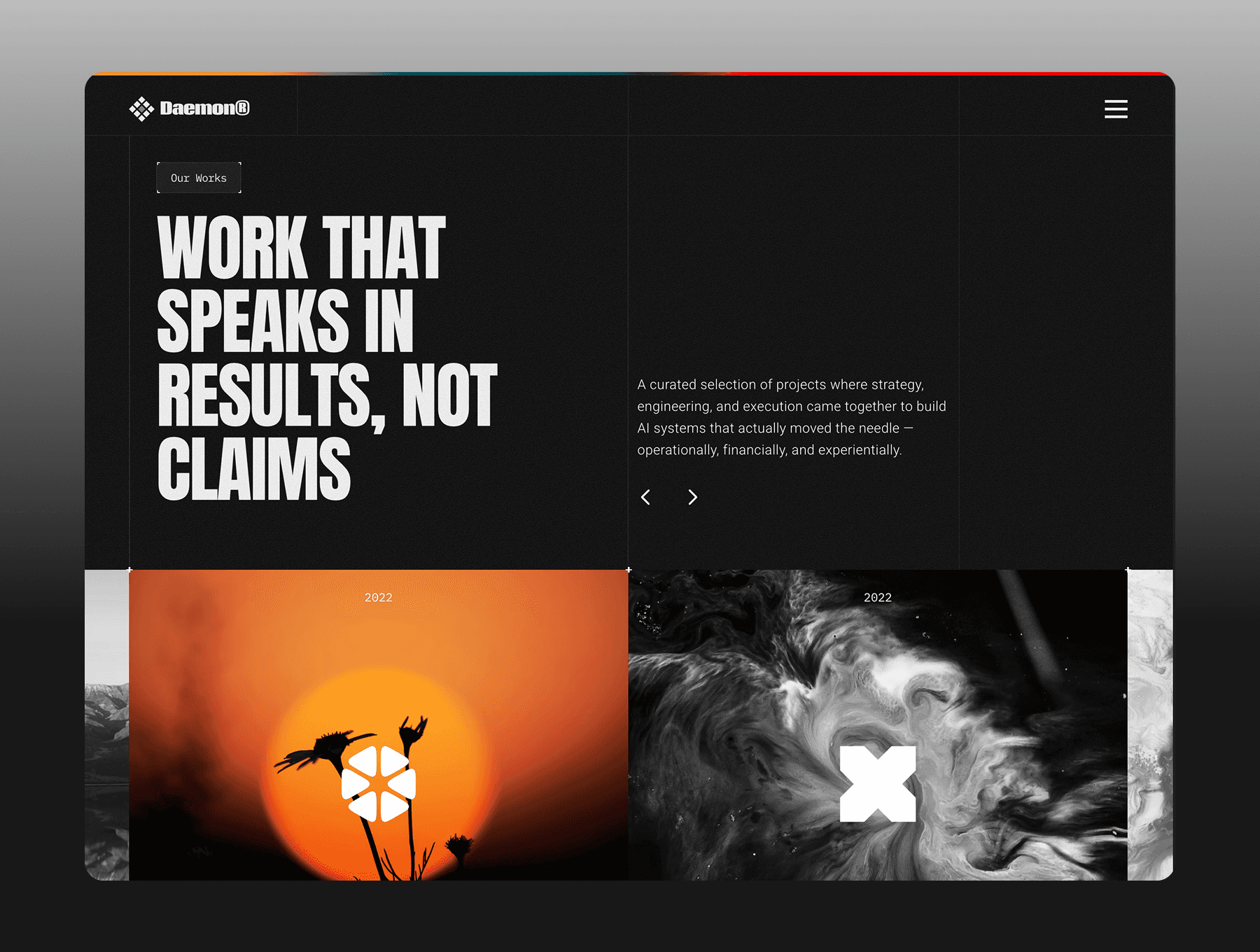
A curated selection of projects where strategy, engineering, and execution came together to build AI systems that actually moved the needle — operationally, financially, and experientially.



Buy Daemon AI Template
from
$129